English
  Deutsch


Why Is ER4943 Composition Designed to Improve Weldability?
Article Directory
- 1 What "Weldability" Actually Means for a Filler Wire
- 2 Silicon: The Element That Shapes Pool Behavior
- 3 Copper, Magnesium, and the Supporting Elements
- 4 Porosity and Hydrogen Behavior in the Weld Pool
- 5 How ER4943 Compares to Its Predecessor
- 6 Dilution and Base Alloy Compatibility
- 7 Process Considerations for ER4943
- 8 Application Contexts Where the Composition Advantage Is Relevant
- 9 Finding a Supplier Who Can Back the Material with Documentation
- 10 Take the Next Step
Aluminum filler wires are not interchangeable. The alloy composition of a wire determines how the weld pool behaves, how the metal moves from liquid to solid, and whether the finished joint holds up over time. ER4943 sits in a particular part of that picture — an alloy developed to address the gaps left by earlier silicon-based fillers while keeping what those fillers got right. To understand why Aluminum Welding Wire ER4943 is composed the way it is, you have to look at what actually happens during welding. The composition is not arbitrary. Every element present, and every element deliberately kept low, connects to a specific behavior in the arc, the pool, or the solidifying joint.
What "Weldability" Actually Means for a Filler Wire
It Covers More Ground Than One Property
When engineers describe a filler wire as having good weldability, they are not pointing to a single characteristic. A wire that feeds smoothly but produces porous welds is not weldable in any useful sense. Neither is one that resists cracking but runs inconsistently and leaves poor edge transitions.
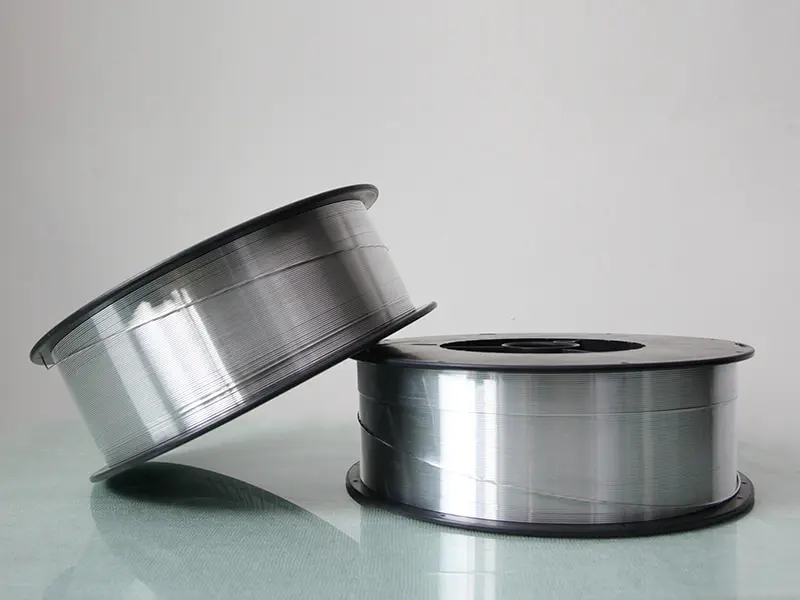
Weldability in practice covers how the wire melts, how the pool flows and spreads, how the metal behaves as it solidifies, and what defects are likely to show up in the finished joint. Aluminum Welding Wire ER4943 is designed with all of those layers in view.
Aluminum Creates Specific Challenges at the Weld Pool Level
Steel welding and aluminum welding operate under different sets of constraints. Aluminum's oxide layer melts at a temperature well above the base metal itself, which can disrupt fusion if the arc conditions are not right. Certain aluminum alloy compositions also have a wide temperature window during solidification — a range where the metal is neither fully liquid nor fully solid — and that window is exactly where hot cracking initiates.
The filler wire composition directly influences how these conditions play out. Adjusting the alloy balance can narrow the solidification window, improve pool flow, and change the stress state during cooling. That is the underlying logic of ER4943's design.
Silicon: The Element That Shapes Pool Behavior
Why Silicon Content Is Central
Silicon is the primary alloying element in ER4943, and its influence on weld behavior runs through nearly every aspect of what makes this wire perform the way it does. At the levels used in this alloy, silicon lowers the melting point of the filler relative to the base metal. That difference is intentional.
When the filler melts before the surrounding base metal, it flows into the joint more freely. It fills gaps without requiring the base metal to reach temperatures that could distort the part or weaken the area around the weld.
Pool Fluidity and What It Changes in Practice
Silicon also affects how the pool moves once it is molten. A pool with adequate silicon content wets out more readily along the joint face, covers irregular surfaces more completely, and produces a flatter bead profile with cleaner edge transitions.
For the person doing the welding, this shows up as a pool that is more responsive and more forgiving. There is more working time before solidification begins, and the risk of cold laps or incomplete fusion at the edges is lower. Consistency across welds — across operators, across conditions — improves.
Narrowing the Solidification Window to Reduce Cracking
Hot cracking in aluminum welds happens in the semi-solid state. The metal is partly liquid and partly solid, and as it contracts during cooling, tensile stresses develop across the joint. If those stresses exceed the strength of the partially solidified network, a crack opens along the grain boundaries.
Silicon-rich fillers like Aluminum Welding Wire ER4943 reduce this risk by narrowing the temperature range over which solidification occurs. A narrower window means less time spent in the vulnerable state, and less opportunity for cracks to develop before the joint has enough strength to resist contraction stresses.
Copper, Magnesium, and the Supporting Elements
Trace Elements and Mechanical Performance
ER4943 is not a binary silicon-aluminum alloy. Its composition includes controlled amounts of other elements that shape the mechanical properties of the finished weld rather than just its formation behavior. These are not incidental — they are part of the design.
Copper, when present in small, controlled amounts, contributes to weld strength through solid solution effects. The constraint is that copper also raises hot cracking susceptibility in aluminum-silicon systems if it goes too high. The inclusion has to be calibrated against that risk, and in ER4943, it is.
How Magnesium Interacts with Silicon in the Pool
Magnesium and silicon interact during solidification in ways that affect both the cooling behavior and the post-weld properties of the joint. In the right proportions, the two elements support the formation of strengthening phases as the weld cools — phases that improve mechanical performance without requiring post-weld heat treatment in many applications.
The magnesium level in ER4943 is set to take advantage of this interaction while staying within a range that does not compromise porosity resistance or overall weld stability. It is a balance, and the design reflects a deliberate choice about where to draw that line.
Porosity and Hydrogen Behavior in the Weld Pool
Where Porosity Comes From in Aluminum Welds
Porosity in aluminum welds is primarily a hydrogen problem. Hydrogen dissolves into the molten pool readily, and as the metal solidifies, its ability to hold hydrogen drops sharply. The hydrogen tries to escape. If the pool solidifies faster than the gas can diffuse out, it gets trapped as small voids inside the weld.
Surface contamination, moisture in shielding gas, and inadequate joint preparation all contribute to hydrogen pickup. But the filler wire composition also plays a role — specifically in how the pool behaves during the window between full liquid and full solid.
How Pool Fluidity Helps Gas Escape
A more fluid pool, supported by silicon content, gives hydrogen more opportunity to rise and escape before the metal locks up. The pool stays workable slightly longer, the surface remains open, and gas that would otherwise be trapped has a path out.
This does not replace the need for clean surfaces and proper shielding. But it means that Aluminum Welding Wire ER4943, under normal operating conditions, is less prone to trapping gas than fillers with faster solidification behavior. For applications with strict quality standards — structural parts, pressure components, anything subject to radiographic inspection — that characteristic becomes a real factor in filler selection.
How ER4943 Compares to Its Predecessor
ER4043's Strengths and Its Limits
ER4043 is the established standard in the silicon-based aluminum filler category. It has a long track record across a wide range of industries, and its weldability characteristics — hot cracking resistance, pool behavior, ease of use — are well understood. For many applications, it remains a straightforward and reliable choice.
Where ER4043 shows its limits is in applications that call for higher weld strength or better ductility in the as-welded condition. Its mechanical properties are adequate for general use but leave a gap when the service demands on the joint are more exacting.
The Changes ER4943 Makes to That Picture
ER4943 retains the silicon-based foundation that makes ER4043 practical but adjusts the overall alloy balance to improve strength and ductility without giving up the handling and fusion characteristics that make the earlier wire useful. The result is a wire that covers more demanding applications without introducing new process complexity.
For welding engineers evaluating filler options for higher-demand aluminum work, Aluminum Welding Wire ER4943 occupies a position the earlier generation did not fully address. It is not a wholesale replacement — the two wires serve overlapping but distinct sets of applications.
Dilution and Base Alloy Compatibility
The Weld Chemistry Is a Mix of Two Inputs
When the filler wire melts into the weld pool, it blends with the melted base metal. The resulting chemistry — the composition of the actual weld — reflects both inputs in proportions determined by penetration depth and heat input. This is dilution, and it matters because filler wire composition cannot be evaluated in isolation from what it is being welded into.
A filler that performs well at low dilution may produce a problematic weld chemistry when dilution is high, and vice versa. The design of ER4943 takes this into account.
Compatibility with 6000-Series Base Alloys
The 6000-series aluminum alloys are among the more widely used structural aluminum materials in production today. They are also among the more sensitive to hot cracking when welded with the wrong filler — a consequence of their magnesium-silicon composition, which creates a diluted weld chemistry prone to solidification cracking when the filler does not compensate appropriately.
ER4943 is specifically well-suited to welding 6000-series base materials. Its silicon content is calibrated to produce acceptable weld chemistry even after dilution with these alloys, keeping the solidification behavior within a range that avoids cracking rather than pushing toward it.
Process Considerations for ER4943
Feed Behavior and Equipment Compatibility
Aluminum welding wire in general is softer than steel wire and more sensitive to feeding problems if the drive system, liner, and contact tip are not matched to the material. Kinking, birdnesting, and inconsistent feed speed are common complaints in shops that try to run aluminum wire through equipment set up for steel.
Aluminum Welding Wire ER4943, like other silicon-containing aluminum alloys, is slightly harder than pure aluminum wire. That characteristic improves feed consistency to a degree — the wire holds its shape under the mechanical pressure of the drive rolls and through the liner more reliably than softer alloys.
Process Parameters and Arc Stability
ER4943 is compatible with standard GMAW parameters for aluminum, including spray transfer and pulse modes. The pool behavior supported by its composition — fluid, with a manageable solidification window — suits pulse welding well. The cyclic energy input of pulse mode allows the pool to wet out between pulses without overheating the joint, and the pool characteristics of ER4943 work in step with that cycle.
For engineers setting up welding procedures for a new application, the alloy's composition translates into a process window that is reasonably broad. It does not demand narrow parameter settings to perform consistently, which matters in production environments where conditions vary.
Application Contexts Where the Composition Advantage Is Relevant
Where It Makes a Difference
The weldability improvements in ER4943's design are not equally significant across all applications. They become particularly relevant in situations where:
- The base alloy is from the 6000-series and hot cracking risk is a known concern
- The finished weld needs to carry load or meet mechanical property specifications in the as-welded condition
- Production volume is high enough that weld consistency across operators and setups matters
- Quality documentation — radiographic inspection, weld procedure qualification — is part of the project requirements
In lower-demand contexts — light fabrication, non-structural work, decorative applications — the gap between ER4943 and an earlier generation filler may not be significant enough to warrant a material change.
What Sourcing Teams Should Verify
For procurement teams specifying Aluminum Welding Wire ER4943, consistency between production lots is the central concern. Alloy composition that drifts between shipments changes weld behavior even when the welding procedure is held constant. The process looks the same; the results are not.
Standard documentation to request from any supplier:
- Chemical composition certificates, by lot
- Mechanical property data for the wire itself
- Packaging and storage requirements to prevent moisture uptake before use
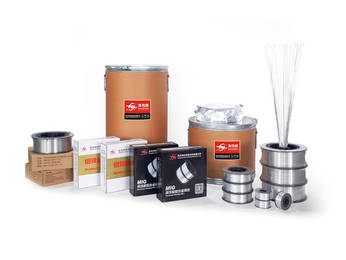
- Available diameters and spool or coil configurations for the intended equipment
Finding a Supplier Who Can Back the Material with Documentation
Technical performance on paper only holds if the production process reproduces the alloy composition reliably from one lot to the next. Variation in trace element levels — even within a range that might appear acceptable on a single certificate — can shift weld behavior in ways that are hard to diagnose without tracing the material.
A reliable manufacturer of Aluminum Welding Wire ER4943 should be able to demonstrate that their production is built around lot-level consistency and full chemical traceability, with certification documentation available to support welding procedure qualification and formal quality control requirements. Sourcing teams and welding engineers can request material specifications, samples, or work through supply arrangements suited to their application volume.
Take the Next Step
If you are working through filler wire selection for an aluminum welding application, or evaluating Aluminum Welding Wire ER4943 for a current project, a direct conversation with a supplier who can provide material documentation alongside the product is a practical next step. Reach out to Hangzhou Kunli Welding Materials Co., Ltd. to request samples, review lot certifications, or discuss supply terms suited to your production requirements.
NEXT:When to Use ER4943 for Automotive Aluminum Component Welding