English
  Deutsch


Why Is Aluminum Welding Wire ER4943 a Game Changer?
Article Directory
Pick the wrong filler metal and the rest of your process barely matters. Fabricators know this. So do purchasing managers who have had to explain a rework batch to a customer. For shops working with aluminum, the wire selection conversation almost always circles back to the same two names: 4043 and 5356. They are familiar, they are available, and they get the job done -- up to a point. Aluminum Welding Wire ER4943 has been drawing more attention lately, not because it is a radical departure from either of those options, but because it quietly addresses the gap between them. Understanding where it fits, where it does not, and why it behaves the way it does is worth the time before you place your next order.
What Exactly Is ER4943?
Think of it as 4043 with a deliberate upgrade baked in. The base chemistry is still aluminum-silicon, familiar territory for anyone who has run 4043 through a MIG gun. What changes is the addition of magnesium to the alloy, and that single modification has a ripple effect across the wire's mechanical behavior.
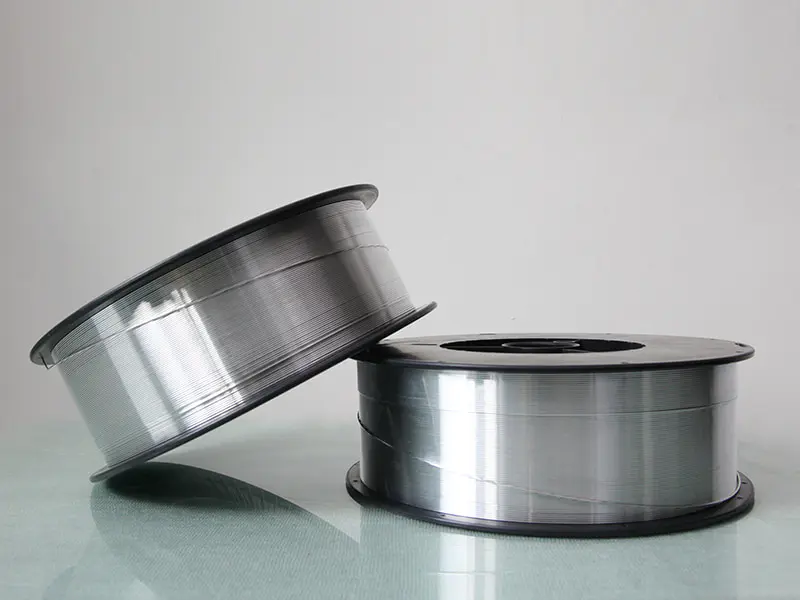
Here is what that translates to in practice:
- Alloy base: Aluminum-silicon-magnesium -- same family tree as 4043, different branch
- Strength source: Magnesium carries the strength, so it does not have to be borrowed from the base metal through dilution
- Heat response: Fully heat-treatable after welding, including post-weld age hardening -- something 5356 cannot do
- Process fit: Runs on the same voltage and wire feed speed as 4043, no procedure rewrite needed
- Base metal range: 1xxx, 3xxx, 4xxx, 6xxx, select 5xxx alloys with lower magnesium content, and a range of cast alloys
That last point about procedure compatibility matters more than it might seem. Shops often resist switching wires because the requalification paperwork is a headache. With ER4943, that concern largely goes away since it was specifically designed to share procedure specs with 4043 and 4643.
Now, the dilution issue deserves its own moment. When you weld with 4043, the weld's final strength is partly a function of how much base metal bleeds into the puddle. Torch angle, travel speed, amperage, even the mood of the welder that day -- all of it shifts penetration depth, which shifts dilution, which shifts your weld strength away from what you calculated. ER4943 sidesteps this entirely. The magnesium is already in the wire. Strength becomes repeatable rather than estimated.
So What Actually Sets It Apart from the Old Standards?
4043 and 5356 have been reliable workhorses for decades, and there is no argument there. But reliability and versatility are not the same thing. Each wire has a ceiling, and each has a specific weakness that tends to show up at the wrong moment.
The differences worth tracking:
- Strength -- As-deposited tensile and yield strength are noticeably higher than 4043, without the alloy compatibility friction that sometimes comes with 5356.
- Weld behavior -- Fluidity, arc stability, and feeding smoothness align with what 4043 provides. Smut and post-weld discoloration also tend to be less pronounced than with many 5xxx series wires, which reduces cleanup time.
- Cracking -- Hot cracking sensitivity stays low, a real concern on 6xxx alloys in tight joint configurations.
- Heat treatment -- This is where it genuinely pulls ahead of 5356. Post-weld age hardening is possible, which opens up applications that 5356 simply cannot serve.
Put another way: it welds like 4043, holds up more like a structural wire, and gives you heat treatment options that the magnesium-based fillers cannot match.
ER4943 vs. 4043: Is the Upgrade Worth It?
4043 earns its reputation. Clean puddle, low cracking risk, good fluidity, acceptable corrosion resistance -- it covers a wide range of general aluminum work without much fuss. For repair shops and fabricators running light-duty assemblies or working with casting alloys, it remains a completely reasonable choice.
Where it runs short is strength. The as-welded tensile and yield values are modest, and in load-bearing joints or structurally critical parts, that limitation becomes visible. There is also the dilution dependency discussed earlier -- experienced welders can account for it, but it introduces variability that not every shop wants to manage.
Side-by-side breakdown:
| Property | ER4043 | ER4943 |
|---|---|---|
| Alloy Base | Aluminum-silicon | Aluminum-silicon-magnesium |
| Tensile Strength (as-deposited) | Lower | Noticeably higher |
| Yield Strength (as-deposited) | Lower | Noticeably higher |
| Hot Crack Resistance | Good | Good |
| Weld Fluidity | Smooth | Smooth, comparable |
| Weld Smut and Discoloration | Low | Low |
| Heat Treatability | Yes | Yes |
| Dilution Dependency | Higher | Lower |
| Anodizing Response | Poor (darkens) | Poor (similar limitation) |
| Base Metal Match (6xxx series) | Good | Good |
| Typical Use Cases | General fabrication, repair, castings | Structural, automotive, load-sensitive joints |
Both wires share a low shrinkage rate, which keeps distortion down in precision work and high-volume runs alike. ER4943 brings that same benefit and adds consistency in weld strength on top. For general-purpose work with modest load requirements, 4043 holds its ground. For anything that needs more from the joint, the case for upgrading is straightforward.
ER4943 vs. 5356: A Different Kind of Trade-Off
5356 plays a different game. It is magnesium-based rather than silicon-based, which gives it stronger raw tensile output and genuinely good corrosion behavior in saltwater environments. Fabricators working on boat components or marine structures often default to it for exactly that reason. It also anodizes better, producing a closer color match to the base metal -- useful when aesthetics matter.
That said, there are situations where 5356 creates problems rather than solving them. It is not recommended for parts that will see sustained elevated temperatures in service, where stress corrosion can become a concern in certain alloy pairings. On 6xxx base alloys specifically, its hot cracking tendency is higher than you want in a tight joint. And post-weld heat treatment? Essentially off the table with 5356, which limits where it can go in the production chain.
ER4943 handles several of those gaps directly. Hot cracking stays low even on 6xxx alloys. Heat treatment after welding is fully supported. Arc behavior and feeding feel closer to 4043 than 5356, which welders tend to appreciate in production settings. Smut levels are lower too, cutting the time spent on post-weld cleanup.
The honest summary: if your priority is saltwater corrosion resistance and anodizing color match, 5356 may still win. If you are welding 6xxx alloys and need a wire that is stronger than 4043, friendlier to heat treatment than 5356, and less likely to crack in demanding joint geometries -- ER4943 covers that ground more cleanly than either traditional option.
Where Does It Actually Get Used?
The wire shows up across a wider range of industries than you might expect:
- Automotive fabrication -- Frames, crossmembers, structural brackets where both strength and crack resistance are non-negotiable
- Aerospace hardware -- Structural welding where mechanical repeatability is tracked closely
- General fabrication -- 6061 and 6063 assemblies, enclosures, frames
- Repair work -- 6xxx base metals under stress, where dilution-dependent fillers introduce too much guesswork
- Cast alloy repair and fabrication -- Compatible with common casting alloys, which broadens its repair shop utility
- Marine and shipbuilding -- A reasonable option where strength and corrosion resistance both matter, though shops prioritizing saltwater protection above all else may still lean toward 5356
- Sporting goods and consumer products -- Bicycles, scooters, ladders, where light weight and finish quality are both on the list
- Production environments -- Smooth feeding and low cleanup needs make it practical at volume
One thing to flag on finishing: like 4043, this wire darkens when anodized. Welds made with any silicon-bearing filler will stand out against the base metal after anodizing treatment. If uniform appearance after anodizing is a hard requirement, the filler choice conversation needs to go a different direction entirely, regardless of strength or performance.
What to Check Before Making the Switch
Switching is not difficult -- but a few things are worth confirming before you commit:
- Base metal identity. Strong match for 6xxx, 1xxx, 3xxx, and 4xxx alloys. For 5xxx series, the magnesium content of the base metal determines compatibility, so do not assume.
- Joint load requirements. If the strength demands genuinely exceed what any silicon-based filler can provide, 5356 or a higher-grade option may still be the right answer.
- Service temperature. 4xxx series wires, including this one, handle elevated service temperatures reasonably well -- an area where 5356 runs into restrictions.
- Post-weld heat treatment. If your parts go through aging or heat treatment after welding, this wire supports that process. 5356 does not.
- Shielding gas. Pure argon performs suitably for many applications. An argon-helium blend gives you an edge on thicker sections. Keep flow rates in the appropriate range -- too low risks oxidation, too high can disrupt arc stability.
- Welding position. Silicon-based fluidity is an advantage in flat and horizontal positions. Overhead and vertical work requires proper technique, same as with 4043.
- Storage and packaging. Keep spools in a dry, clean space, away from moisture. In production, consistency across spools matters more than any single-spool result.
Making the Call: A Practical Selection Framework
There is no one-size-fits-all answer here, but the decision usually comes down to a short set of questions.
What is the base metal? For 6xxx series work, this wire is a natural fit. For high-magnesium 5xxx alloys or applications dominated by saltwater corrosion concerns, 5356 may still hold the edge.
Does the joint need more strength than 4043 reliably delivers? If the answer is yes and the application involves 6xxx aluminum, the upgrade argument is strong. If strength demands push beyond what any silicon-based wire can handle, that is a different conversation.
Is cracking a known risk? Constrained joints in 6xxx alloys are where ER4943's low hot cracking sensitivity does meaningful work compared to 5356.
Will the part be heat treated? Yes means 5356 is likely off the list. This wire supports post-weld aging, which can be a deciding factor on its own.
Does appearance after anodizing matter? Both 4043 and ER4943 behave the same way here -- silicon-based welds darken. If that is a problem, the answer lies elsewhere. But in cases where appearance is secondary to performance, neither wire puts you at a disadvantage over the other.
What is the welder's background? Anyone comfortable with 4043 can pick this up without much adjustment. Same settings, same general behavior, stronger result.
Making sense of aluminum filler wire options takes some patience -- the differences are real, but they only matter when they are matched to an actual application. Aluminum Welding Wire ER4943 earns its place not by doing everything, but by doing something specific quite well: delivering repeatable weld strength on 6xxx series aluminum without sacrificing the handling characteristics that make silicon-based wires practical to run day in and day out. It does not replace 4043 for light-duty general work, and it does not dethrone 5356 in environments where saltwater corrosion resistance drives every decision. What it does is fill the space between them in a way that holds up under real production conditions. For shops evaluating their aluminum filler supply chain, wire consistency, alloy accuracy, and packaging reliability are what determine whether a good wire performs well in practice. Hangzhou Kunli Welding Materials Co., Ltd. is a supplier worth evaluating on those terms, particularly for operations where weld quality and output consistency need to hold steady across high-volume production runs.
NEXT:Engineering Analysis of Surface Aesthetics and Post-Weld Anodizing Behavior in ER4047 Welding Wire Applications