English
 Deutsch



MIG Aluminum Welding Wire vs TIG Aluminum Welding Rod: Selection Guide
Article Directory
A shop floor decision between MIG aluminum welding wire and TIG aluminum welding rod is rarely about one product being superior. A 12 kg spool of ER5356 MIG wire and a 1 kg bundle of ER5356 straight TIG rods carry the same alloy number, but they serve different production realities. MIG wire must feed through a liner, contact tip, and nozzle without bird nesting or burnback. TIG rod must stay straight, clean, and easy to feed by hand into a small puddle. The same metallurgy behaves differently when deposition is automatic rather than manual.
The conclusion in one sentence: Choose MIG aluminum welding wire when you need deposition rate on 3 mm and thicker material; choose TIG aluminum welding rod when you need heat control and joint cosmetics on thin sections or critical root passes.
Process Differences That Change Filler Selection
MIG welding aluminum uses a continuous wire electrode and an electric arc that melts both the base metal and the wire. TIG welding aluminum uses a non-consumable tungsten electrode, an AC arc, and a separate filler rod. This difference affects how you buy and handle the filler metal.
| Comparison Point | MIG Aluminum Welding Wire | TIG Aluminum Welding Rod |
|---|---|---|
| Filler form | Continuous spooled wire | Cut rod or wire fed by hand |
| Heat control | Set by voltage, wire feed, and trigger | Foot pedal adjusts amperage instantly |
| Practical thickness | Best from 3 mm upward | Best from 0.8 mm to 6 mm |
| Deposition rate | High; multiple kg per hour on long joints | Low to moderate; limited by hand feeding |
| Weld appearance | Slightly convex, commercial finish | Smooth, clean, easy to control on visible surfaces |
| Typical defects | Feed problems, burnback, porosity | Tungsten inclusion, arc wandering, distortion |
| Operator skill | Set-up is critical; technique easier to learn | High manual skill; torch and rod coordination |
Both processes use 100% argon or an argon-helium blend for aluminum. Neither uses flux-cored wire in normal production. The alloy range is the same for MIG wire and TIG rod, which is why the process and joint requirements drive the final purchase decision more than the alloy family alone.
Alloy Families: 4xxx vs 5xxx Fillers
TIG rod and MIG wire are available in the same alloy families. Reading “rod” in a part number does not mean lower quality; it means the material is cut to length and intended for manual feeding. The metallurgical selection logic remains the same.
4xxx Series: Silicon-Based Fillers
ER4043 is the default filler for welding 6061, 6063, and many cast aluminum parts. It contains about 5% silicon, which gives a fluid puddle, good wetting, and resistance to hot cracking. It is forgiving on dirty or mixed base metals and works well in both MIG and TIG applications. The trade-off is lower as-welded strength and a grey or dark finish after anodizing. For repair work and thin extrusions, ER4043 silicon aluminum welding wire is often the first choice.
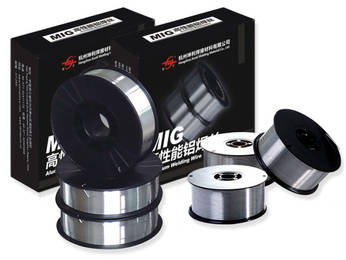
 ER4043 Aluminum Welding Wire Manufacturers,SuppliersAs China ER4043 Aluminum Welding Wire Manufacturers and OEM/ODM Suppliers, Hangzhou Kunli welding materials Co., Ltd. provide wholesale A...View Product →
5xxx Series: Magnesium-Based Fillers
ER5356 adds roughly 5% magnesium and produces higher tensile strength, better color match after anodizing, and stronger corrosion resistance in marine atmospheres. It is a common TIG rod for boat repairs and architectural rails, and a common MIG wire for frames, trailers, and pressure vessels. For 5083 base metal, ER5183 provides slightly higher as-welded strength and better saltwater service than ER5356. Shops that weld marine-grade aluminum often switch to ER5183 aluminum welding wire for structural work. Where the joint must match anodized color after welding, ER5356 aluminum welding wire remains the reference choice.
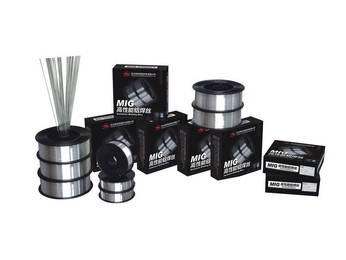
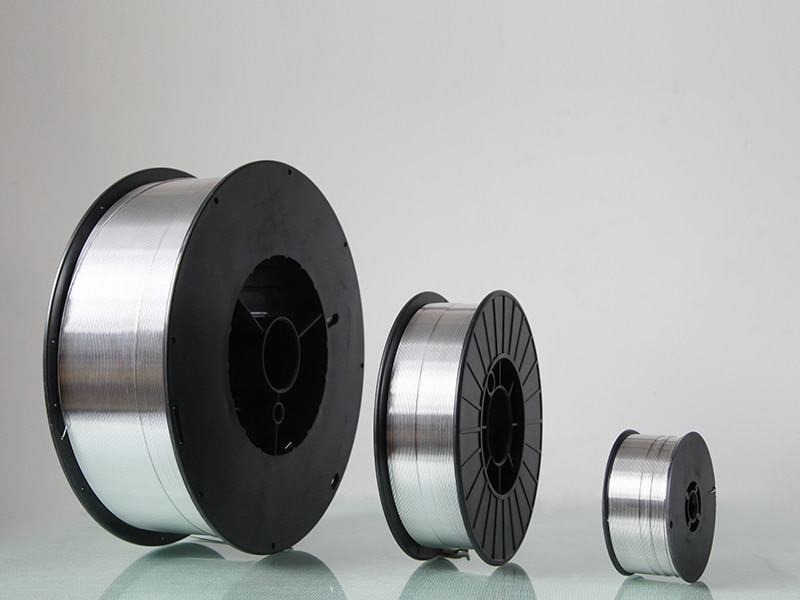 Aluminum Welding Wire ER5356 - Kunliwelding ManufacturerKunli is your go-to wholesaler for Aluminum Welding Wire ER5356, offering ideal corrosion resistance and strength. Suitable for marine, a...View Product →
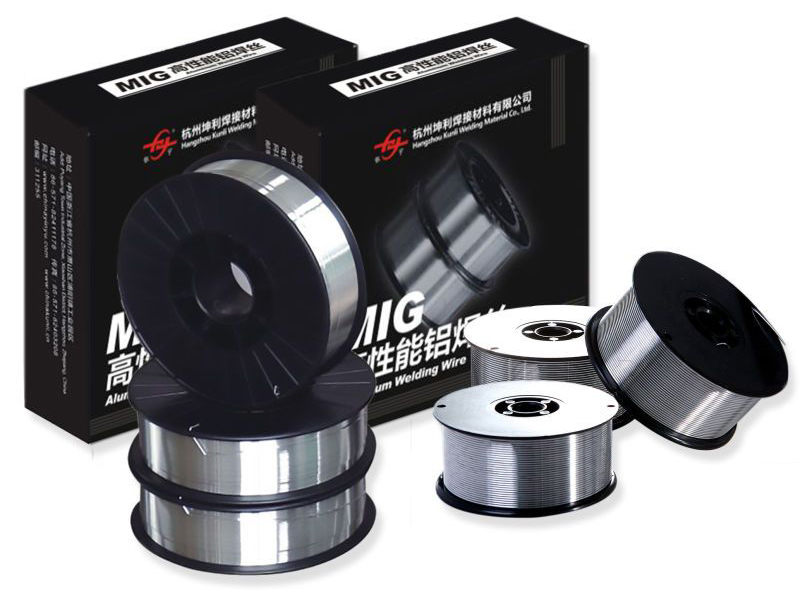 Aluminum Welding Wire ER5183 Manufacturers - Kunli SuppliersAluminum Welding Wire ER5183 supplied by Kunli manufacturer, suitable for automotive, and industrial welding with great strength and corr...View Product →
| Alloy | Series | Key Addition | Best Base Metals | Anodizing | Typical Use |
|---|---|---|---|---|---|
| ER4043 | 4xxx | 5% Si | 6061, 6063, cast | Grey to dark | Extrusions, thin sections, cast repair |
| ER5356 | 5xxx | 5% Mg | 5052, 5083, 6061 | Good color match | Marine, architectural, automotive |
| ER5183 | 5xxx | ~5% Mg plus slight refinements | 5083, 5086, 5052 | Slight color difference | Ships, tanks, high-strength fabrications |
If you are welding 6xxx series aluminum, a 4xxx filler is usually the safer choice when cracking and flow are the main risks. If you need strength and corrosion resistance in a 5xxx base metal, use a 5xxx filler. This rule applies to both spooled MIG wires and straight TIG rods.
Practical Selection Criteria for the Welding Shop
The next step is matching the filler form to the job. Use the following guidance:
- Choose TIG aluminum welding rod when the joint is visible, the base metal is thin, or the specification requires minimum distortion.
- Choose MIG aluminum welding wire when you have long joints, thick sections, or a production schedule that depends on continuous output.
- Match the filler alloy to the base metal: 4xxx for 6xxx and castings, 5xxx for 5xxx and some 6xxx applications.
- Check the diameter: a 1.6 mm rod is practical for TIG on 2–3 mm sheet, while 1.2 mm MIG wire is a common starting point for production welding.
Position and access also matter. A TIG torch can reach tight corners and inside profiles with a shorter rod. A MIG gun is faster on long horizontal fillets and vertical-up welds after the operator develops the technique. If you are setting up an automated or robotic cell, MIG wire is almost always the practical answer because it provides consistent feed and process data.
For a step-by-step breakdown of how to combine these variables, see our guide to MIG and TIG aluminum filler selection. It covers base metal matching, wire feed settings, and common defects in one place.
Quality and Procurement Issues That Decide Project Costs
Aluminum filler metal is not a commodity if the supplier cannot control the production process. The visible differences show up in reject rates, rework, and delivery delays.
- Surface cleanliness. Aluminum oxide absorbs moisture from the air. Poor surface preparation produces porosity in both MIG and TIG welds.
- Diameter tolerance. A wire that drifts outside tolerance changes both feeding and filler volume. For TIG rods, the same issue affects puddle control.
- Cast and helix. For MIG wire, open cast or irregular helix causes wire steering, bird nesting, and uneven arc behavior.
- Straightness. Bent TIG rods are difficult to feed accurately and create variability in long hand welds.
- Traceability. Heat numbers and certified mechanical properties matter more when the weld will be inspected by a third party.
At our plant, spooled MIG wires and cut-length TIG rods are produced with the same alloy control and inspection procedures. Certifications such as DB, CE, ABS, DNV, and CCS support marine, rail, and pressure-related applications. When you work with an experienced aluminum welding wire manufacturer, you can request test certificates, dimensional reports, and lot traceability before the material ships.
Conclusion: Buy the Form That Matches the Joint
To put the decision in one sentence: for thick production work, buy MIG aluminum welding wire; for precise, low-heat joints, buy TIG aluminum welding rod.
Many shops buy both because the application mix changes from job to job. A repair shop may need only TIG rods for thin sheet, small tanks, and visible frames. A fabricating line may need ten spools of MIG wire for a single batch. If you run both types of work, a supplier who can deliver both products from one heat simplifies your inventory and documentation.
When you compare prices, compare the total cost per finished weld, not just the cost per kilogram. MIG wire appears cheaper in large spools, but set-up and shielding gas flow can offset that advantage on short jobs. TIG rods are easy to store and do not require a wire feeder, but operator time is often the larger cost.
Keep the material specification simple, verify the supplier’s quality system, and choose the form that your equipment and production volume can actually support. If you are planning a large order or a new process validation, talk to a trusted aluminum filler metal supplier about alloy, diameter, and packaging options.
NEXT:Quality Standards for Aluminum Welding Wire Manufacturing: What Buyers Must Know