English
  Deutsch


ER5087 Aluminum Welding Wire: Industrial Uses, Strength & Marine Applications
Article Directory
- 1 What ER5087 Aluminum Welding Wire Is Used for in Industrial Applications
- 2 ER5087 vs ER5356: Strength, Corrosion Resistance, and When to Choose Each
- 3 Marine Welding with ER5087: Performance in Saltwater Environments
- 4 Compatible Base Metals for ER5087 Aluminum Welding Wire
- 5 Advantages of ER5087 for Shipbuilding and Structural Welding
- 6 How to Select ER5087 for High-Corrosion Environments
When a weld must hold in saltwater, structural load, or chemically aggressive environments, the filler wire you select determines whether the joint lasts a decade or a lifetime. ER5087 aluminum welding wire is a high-magnesium, zirconium-bearing filler alloy engineered specifically for demanding industrial and marine applications where standard alloys fall short.
What ER5087 Aluminum Welding Wire Is Used for in Industrial Applications
ER5087 is used wherever aluminum joints must combine high tensile strength with superior resistance to corrosion, stress-cracking, and weld porosity. Unlike general-purpose fillers, ER5087 contains a deliberate zirconium addition (0.10–0.20%) that refines the weld grain structure, reduces hot-cracking sensitivity, and improves overall mechanical performance in multi-pass welds.
Primary industrial applications include:
- Shipbuilding and offshore platform fabrication
- Pressure vessels and cryogenic storage tanks
- Structural aluminum frameworks for bridges and rail cars
- Armored vehicle hulls and military-grade structural components
- Chemical processing equipment exposed to chloride or acidic media
- High-cycle fatigue structures such as aircraft ground support frames
ER5087 is a 5xxx-series aluminum filler alloy distinguished by its zirconium grain-refining addition, producing weld deposits with higher crack resistance and finer columnar grain structure than conventional high-magnesium fillers.
ER5087 vs ER5356: Strength, Corrosion Resistance, and When to Choose Each
ER5087 and ER5356 are both high-magnesium 5xxx-series fillers, but they serve different performance tiers. ER5087 outperforms ER5356 in three measurable ways: crack resistance, grain refinement, and long-term saltwater corrosion performance.
- Tensile strength: ~290 MPa
- Zirconium-refined grain structure
- Superior hot-crack resistance
- Excellent for thick-section, multi-pass welds
- Preferred for marine and offshore environments
- Lower porosity in high-heat applications
- Tensile strength: ~260–270 MPa
- Standard grain structure
- Good general corrosion resistance
- Widely available, cost-effective
- Suitable for light structural and decorative work
- Not recommended for sustained elevated-temperature service
When the base metal is a 5083, 5086, or 5456 alloy under sustained load in a marine environment, ER5087 is the technically superior choice. For general automotive trim or non-structural fabrication, ER5356 remains the practical default.
Marine Welding with ER5087: Performance in Saltwater Environments
ER5087 aluminum welding wire is fully suitable for marine welding applications and is actively specified by shipbuilders working with 5083-H116 and 5086-H34 hull plate alloys. The U.S. Navy and several European classification societies accept ER5087 for structural hull welds where resistance to stress-corrosion cracking (SCC) is a primary design requirement.
Three properties make ER5087 particularly effective in marine service:
- The zirconium addition suppresses sensitization — the metallurgical process that makes 5xxx alloys vulnerable to intergranular corrosion after prolonged exposure to temperatures between 65°C and 175°C.
- High magnesium content (up to 5.5%) creates a weld deposit that is chemically matched to the base metal, minimizing galvanic potential differences at the fusion zone.
- Refined grain structure produced during solidification reduces micro-void formation, cutting the pathways through which chloride ions penetrate the weld.
Marine Industry Note
Bureau Veritas and DNV GL both approve ER5087 filler wire for welded aluminum hull structures in seagoing vessels. This approval reflects its demonstrated resistance to pitting and crevice corrosion in continuous seawater immersion testing exceeding 10,000 hours.
Compatible Base Metals for ER5087 Aluminum Welding Wire
ER5087 is designed for welding 5xxx-series aluminum alloys and is also compatible with several 6xxx-series base metals when corrosion resistance takes priority over crack sensitivity concerns.
| Base Metal | Compatibility | Typical Application |
| 5083 | Excellent | Marine hulls, cryogenic vessels |
| 5086 | Excellent | Offshore platforms, pressure tanks |
| 5456 | Excellent | Structural frames, armor plate |
| 5052 | Good | Sheet metal fabrication |
| 6061 | Acceptable | Structural extrusions (corrosion-priority joints) |
| 6082 | Acceptable | European structural alloy, bridges, rail |
ER5087 is not recommended for welding 2xxx or 7xxx-series alloys, which require specialized fillers designed for their higher copper or zinc content.
Advantages of ER5087 for Shipbuilding and Structural Welding
ER5087 aluminum welding wire delivers four measurable advantages over alternatives in shipbuilding and heavy structural work:
- Hot-crack resistance: Zirconium grain refinement dramatically reduces solidification cracking in restrained joints — a critical factor in hull stiffener welds where thermal contraction forces are high.
- Multi-pass weld integrity: The refined microstructure retains mechanical properties through repeated thermal cycles, making ER5087 reliable for thick-section butt welds requiring 4–8 passes.
- Long fatigue life: Lower porosity and finer grain boundaries produce welds with superior resistance to crack initiation under cyclic loading — essential for vessel hull structures subject to wave-induced stress.
- Weld bead aesthetics: Produces a smooth, bright bead with minimal spatter, reducing post-weld grinding time in visible structural areas.
How to Select ER5087 for High-Corrosion Environments
Selecting the right filler wire for a high-corrosion environment requires matching three variables: base metal alloy, service temperature, and exposure medium. ER5087 is the correct choice when all three of the following conditions apply.
Key Selection Takeaways
- Use ER5087 over ER5356 whenever the joint will face sustained saltwater or chloride exposure.
- Always request the mill test report and verify zirconium content before production welding.
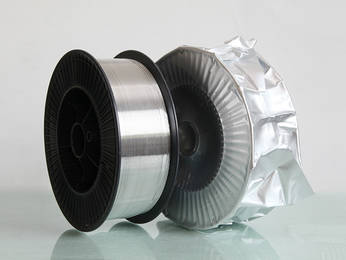
- Store spooled wire in sealed packaging with desiccant — moisture contamination increases porosity in aluminum welds regardless of filler quality.
- For MIG (GMAW) applications, use argon shielding gas at 15–20 L/min; helium blends improve penetration on sections above 12 mm.
NEXT:How to Choose Aluminum Welding Wire for Sale in Industry?