English
  Deutsch


How to Choose Aluminum Welding Wire for Sale in Industry?
Article Directory
- 1 What Is Aluminum Welding Wire Used For?
- 2 How to Choose the Right Alloy Type
- 3 Aluminum Welding Wire for Different Project Types
- 4 Side-by-Side Comparison: 5356 vs 4943 vs 5183
- 5 What Should Procurement Teams Consider When Sourcing?
- 6 Making the Selection Decision: A Practical Decision Path
- 7 Bringing Selection and Procurement Together
Selecting the wrong filler metal for an aluminum welding job does not always produce immediate failure. Sometimes the weld holds — but cracks under fatigue loading months later. Sometimes it passes visual inspection but shows porosity under NDT. And sometimes the joint simply does not reach the mechanical properties the design requires, a shortfall that only becomes visible when the structure is put under real service conditions. For engineers and procurement teams evaluating Aluminum Welding Wire for Sale, the alloy designation printed on the spool is not a minor specification detail — it determines how the finished weld behaves under stress, in corrosive environments, and across temperature cycles that real industrial applications impose.
What Is Aluminum Welding Wire Used For?
Aluminum filler wire is consumed during the welding process to join aluminum base materials. It melts into the weld pool alongside the base metal, contributing to the joint's mechanical properties, corrosion resistance, and crack resistance. The filler wire composition is not identical to the base metal — it is formulated to compensate for the changes that occur when aluminum is melted and resolidified, particularly the tendency for certain aluminum alloys to crack during the cooling phase of welding.
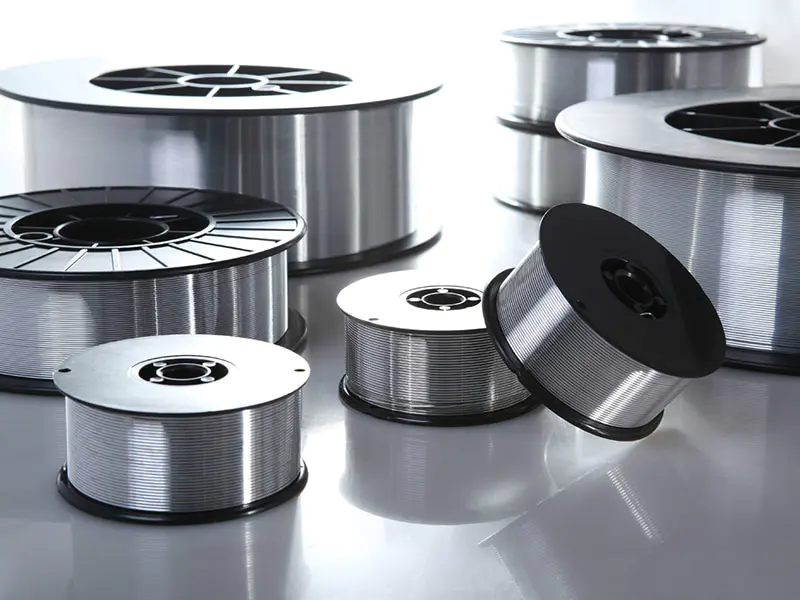
The wire is used across MIG (GMAW) and TIG (GTAW) welding processes, with MIG aluminum welding wire applications dominating in higher-volume industrial production due to the process speed and automation compatibility that MIG welding offers.
Common Industries Using Aluminum Welding Wire
The range of applications is broad, but the industries with substantial consumption and clearly differentiated alloy requirements include:
- Marine fabrication — boat hulls, deck structures, offshore platforms, and marine equipment where saltwater corrosion resistance is a primary performance requirement
- Automotive manufacturing — body panels, chassis components, suspension parts, and heat exchangers where weight reduction drives aluminum adoption and weld strength is a safety-critical factor
- Structural and architectural fabrication — commercial buildings, bridges, rail vehicles, and modular structures where both aesthetics and structural integrity matter
- Pressure vessels and piping — chemical processing and industrial plant equipment where weld integrity under pressure and exposure to process chemicals defines safe operation
- Aerospace and defense — structural components where the strength-to-weight ratio is the defining engineering requirement
Why Selection Matters for Weld Quality
The filler wire alloy affects more than just the weld's chemistry. It influences:
- Hot crack sensitivity — whether the weld metal solidifies without cracking along the grain boundaries
- Mechanical strength of the completed joint — which may be lower or higher than the base metal depending on the filler choice
- Corrosion resistance in service — particularly in environments with chloride exposure, moisture cycling, or chemical contact
- Post-weld treatment compatibility — whether the joint can be heat-treated, anodized, or coated without adverse effects
- Wire feedability in MIG applications — softer alloys can feed inconsistently through liner systems designed for harder wire, affecting arc stability and weld consistency
How to Choose the Right Alloy Type
The aluminum filler alloy selection process is driven primarily by the base material being welded and the performance requirements of the finished joint. No single filler wire serves every aluminum welding application equally well — each alloy carries trade-offs that only resolve clearly once the use case is defined.
5356 vs 4943 vs 5183 Comparison Overview
These three alloys represent distinct approaches to the strength-corrosion-crackability trade-off that defines aluminum filler selection.
5356 Alloy Aluminum Wire is a magnesium-based filler that has become widely used across general industrial welding applications. The magnesium content provides solid mechanical strength in the as-welded condition and good resistance to corrosion in marine and outdoor environments. It welds cleanly on many 5xxx series base alloys and offers reliable feedability in MIG applications. The limitation is its sensitivity to elevated temperature service — 5356 is not recommended for applications where the weld will be exposed to sustained temperatures above a certain threshold, as it can become susceptible to sensitization and stress corrosion cracking over time.
4943 Aluminum Welding Wire is a relatively newer alloy that addresses a gap between the established 4043 and 5356 families. It combines silicon content (from the 4xxx family) for improved crack resistance and feedability with added magnesium that raises the as-welded mechanical properties closer to 5356 levels. The result is a filler that welds more smoothly than 5356 on crack-sensitive base alloys while delivering stronger joints than standard 4043. For automotive structural components — particularly those involving 6xxx series base alloys — 4943 has become an increasingly specified choice because it reduces hot cracking risk while maintaining the mechanical performance that safety-critical joints require.
5183 Aluminium Mig Wire sits at the high-strength end of the aluminum filler spectrum. With higher magnesium content than 5356, it develops greater tensile strength in the deposited weld metal. This makes it the specified choice for structural applications where weld strength is the driving requirement — large structural fabrications, transportation equipment, and marine structures carrying significant loads. The trade-off is that 5183 can be more demanding to feed in MIG applications due to its relative softness, and it requires more attention to liner condition and drive roll selection to maintain consistent feeding over longer production runs.
Strength, Corrosion Resistance, and Compatibility
Understanding how these three alloys rank across the key performance dimensions helps clarify when each is appropriate:
Tensile strength in the as-welded condition generally follows: 5183 above 5356, 5356 above 4943, and 4943 above standard 4043. However, strength ranking alone does not determine the right choice — a filler that produces a stronger weld but introduces hot cracking risk is not serving the application.
Corrosion resistance in marine environments favors the 5xxx alloys (5356 and 5183) over silicon-containing 4xxx alloys. The magnesium in 5xxx fillers contributes to forming a more protective oxide layer in saltwater and humid environments. For any application with chloride exposure, 5356 or 5183 is the appropriate family; 4943 and 4043 are less suitable for sustained marine service.
Compatibility with base alloys is a key filter in any selection process:
- 5xxx series base alloys (such as 5052, 5083, 5086) are typically welded with 5356 or 5183 filler
- 6xxx series base alloys (such as 6061, 6063, 6082) are crack-sensitive and are welded with either 4943 or 4043 to reduce hot cracking risk
- Mixed joints between 5xxx and 6xxx base alloys require careful filler selection — 5356 can be used in some configurations, but 4943 increasingly covers this requirement in automotive applications
Aluminum Welding Wire for Different Project Types
Marine Applications
Marine aluminum welding wire must prioritize saltwater corrosion resistance above other performance factors. Hulls, deck fittings, structural frames, and fuel tank assemblies in marine environments face continuous exposure to chloride-laden water and air — a combination that causes rapid degradation in alloys that lack adequate corrosion resistance in the weld zone.
For marine fabrication:
- 5083 and 5086 base alloys are standard in hull construction for their inherent marine corrosion resistance
- 5356 filler wire erves as a common marine aluminum welding wire for many structural marine joints — it maintains corrosion performance compatible with the base alloy and provides adequate strength for structural applications
- 5183 filler is specified for high-load structural marine applications where weld strength requirements exceed what 5356 delivers
- Avoid 4xxx family fillers in marine structural applications — the silicon content does not offer the corrosion resistance profile that marine service demands
The welding process in marine fabrication is frequently MIG due to production volume requirements, which means wire feedability is a practical consideration alongside alloy performance. Both 5356 and 5183 feed adequately in well-maintained MIG setups, though 5183 requires more attention to liner condition.
Automotive Applications
Automotive aluminum welding presents a different set of requirements. Weight reduction in vehicle structures has driven broad adoption of 6xxx series alloys — 6061 and 6082 in particular — for body-in-white components, chassis structures, and suspension elements. These alloys are crack-sensitive when welded, and filler selection is critical to avoiding hot cracking in joints that carry dynamic fatigue loads in service.
For automotive structural welding:
- 4943 Aluminum Welding Wire has become the preferred filler for welding 6xxx series automotive alloys — it reduces hot cracking sensitivity while delivering stronger joints than standard 4043
- 4043 remains in use for non-structural or lower-stress automotive joints where the slightly lower strength is acceptable and smooth weld appearance is prioritized
- 5356 can be used on some automotive applications involving 5xxx series base materials, but it is not recommended for 6xxx series base alloys due to hot cracking risk
Automotive production environments also place high demands on wire feedability and arc consistency because of the production volumes and automated welding systems involved. 4943's feedability advantage over 5356 in these systems is a practical consideration that influences alloy adoption independently of the metallurgical arguments.
Structural and Heavy Fabrication
For structural fabrication — rail vehicles, large-scale commercial structures, industrial equipment frames — the performance requirements vary more widely than in marine or automotive contexts, and filler selection depends more specifically on the base alloy combination and the load case.
General guidance for structural aluminum welding:
- 5356 covers the majority of structural applications involving 5xxx series base alloys at moderate strength requirements
- 5183 is appropriate when weld strength must approach or match the strength of the base alloy — high-load structural connections, main beam welds, or joints in seismically exposed structures
- 4943 is the right choice when 6xxx series alloys are involved in structural applications — offering crack resistance with higher strength than 4043
The high strength aluminum welding wire category — effectively 5183 in MIG applications — is increasingly specified in transportation infrastructure projects where structural redundancy cannot compensate for underperforming welds.
Side-by-Side Comparison: 5356 vs 4943 vs 5183
| Performance Factor | 5356 Alloy | 4943 Alloy | 5183 Alloy |
|---|---|---|---|
| Base composition | Aluminum-magnesium | Aluminum-silicon-magnesium | Aluminum-magnesium (high Mg) |
| As-welded strength | Good | Moderate to good | High |
| Hot crack resistance | Moderate on 6xxx alloys | Strong — suits crack-sensitive base alloys | Moderate — suited to 5xxx alloys |
| Corrosion resistance (marine) | Good | Lower — less suited for marine | Good to high |
| MIG feedability | Good | Good to strong | Moderate — requires liner attention |
| Compatibility with 5xxx alloys | Strong | Moderate | Strong |
| Compatibility with 6xxx alloys | Limited — cracking risk | Good — preferred choice | Limited |
| Elevated temperature service | Limited — sensitization risk | Better | Limited |
| Typical applications | General industrial, marine, structural | Automotive, 6xxx alloy fabrication | Heavy structural, marine high-load |
| Anodizing result | Darker weld zone | Lighter weld zone | Darker weld zone |
What Should Procurement Teams Consider When Sourcing?
Technical alloy selection is only part of the procurement decision. For industrial buyers evaluating aluminum welding wire suppliers, several additional factors affect whether the specified wire performs consistently in production.
Batch-to-batch consistency is a genuine production concern. Wire that varies in composition, surface cleanliness, or dimensional tolerance between production lots introduces variability into the welding process — variability that shows up as arc instability, porosity, or inconsistent mechanical properties in the deposited weld. Suppliers with documented quality management and lot traceability systems reduce this risk.
Surface condition of the wire directly affects arc quality in MIG welding. Aluminum wire is sensitive to surface oxide accumulation and drawing lubricant residue. Wire that has been stored improperly or handled without adequate packaging protection can develop surface contamination that causes porosity and arc instability.
Spool and packaging specifications need to match the feeding system in use. Wire diameter, spool dimensions, and core size must correspond to the drive roll and liner configuration on the welding equipment. Mismatched spooling creates feeding problems that are sometimes diagnosed as alloy or equipment issues when the root cause is a packaging specification mismatch.
Certification and compliance documentation may be required for welding procedures in regulated industries — marine classification, automotive supplier qualification, structural welding codes, and pressure vessel fabrication all have documentation requirements that the wire supplier must be able to support.
Making the Selection Decision: A Practical Decision Path
For buyers and engineers working through filler wire selection, a structured decision sequence helps avoid common errors:
- Identify the base alloy or alloy combination — this is the primary filter, determining which fillers are metallurgically compatible
- Assess the crack sensitivity of the joint — 6xxx base alloys and dissimilar joints require crack-resistant fillers (4943 or 4043); 5xxx base alloys are generally more tolerant of 5356 and 5183
- Define the corrosion environment — marine and outdoor exposure environments favor 5xxx fillers; indoor or controlled environments are more tolerant of 4xxx fillers
- Establish the strength requirement — does the weld need to approach base metal strength, or is a lower-strength filler acceptable given the joint design?
- Consider the welding process and production environment — MIG production environments with long liner runs need to account for feedability; TIG applications are less sensitive to this
- Review any applicable welding procedure or certification requirements — confirm that the selected filler is approved for the relevant welding procedure specification
Bringing Selection and Procurement Together
Aluminum filler wire selection is a technical decision with direct procurement consequences. The alloy that fits the application may not be readily available from local sources, and the supplier with a low price may lack the batch consistency or documentation that a regulated application requires. Getting the selection right — matching alloy type to base material, service environment, and mechanical requirements — is the foundation. Finding a supplier who can deliver that alloy consistently, with adequate quality documentation and packaging appropriate for the production environment, is the next step. For industrial buyers and welding engineers evaluating corrosion resistant aluminum welding wire, high strength options, or specific alloys like 5356, 4943, and 5183 for MIG aluminum welding wire applications, Hangzhou Kunli Welding Materials Co., Ltd. offers a comprehensive range of aluminum filler products with the technical support and quality consistency that industrial production requires. If your current specification involves one of these alloys, or if you are comparing options for a new application, reaching out with the base alloy, joint design, and service environment details is a productive starting point for a sourcing conversation.
NEXT:5356 Alloy Aluminum Wire: Properties and Industrial Uses