English
 Deutsch



Aluminum Welding Wire Diameter: Keep Metric and Inch Orders Clear
Article Directory
- 1 Identify the diameter supplied for the actual product
- 2 Distinguish conversion from a nominal size
- 3 Keep nominal diameter and tolerance separate
- 4 Review the equipment information with the welding team
- 5 Compare documents using one clear record
- 6 Make receiving checks match the agreement
- 7 Preserve clarity in repeat orders
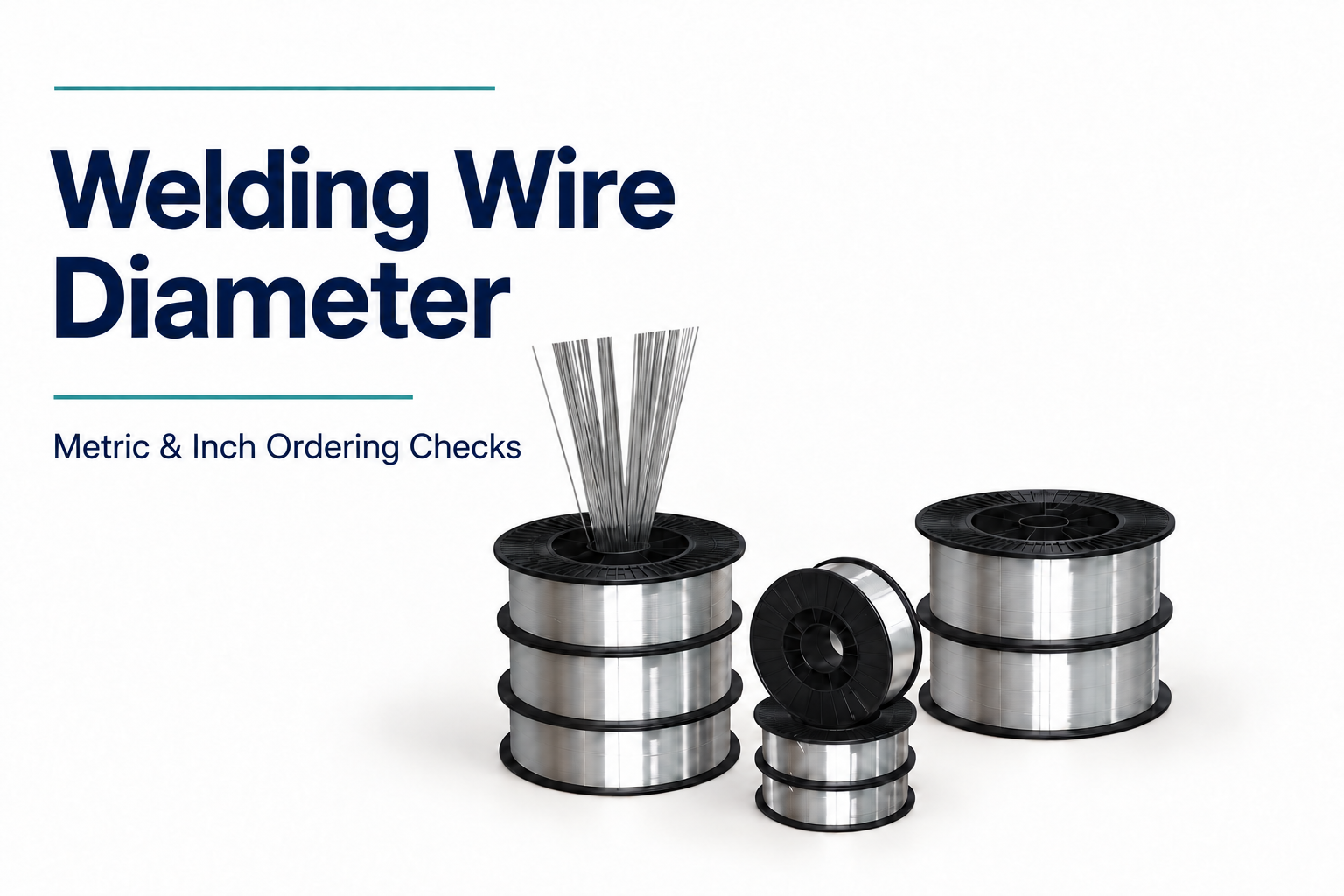
A consumable order can become unclear when the enquiry uses millimetres, the machine documentation uses inches and the quotation shortens the size description. Aluminum welding wire diameter should be recorded with its unit and nominal designation before a sample or repeat order is approved.
The problem is not simply arithmetic. A converted value, a catalogue size and the permitted manufacturing tolerance are different pieces of information. Procurement needs them to refer to the same offered product, while the welding team must confirm suitability for the equipment and approved procedure.
Identify the diameter supplied for the actual product
Request the nominal diameter and unit for the specific wire being offered. Keep the alloy classification and pack reference alongside it. A supplier may list several diameters within the aluminum welding wire range, so a general product category does not identify the size that will arrive.
If the order is based on a sample, preserve the sample's complete label information. Do not reduce the repeat order to a photograph of the spool or a short description such as standard aluminum wire. The size, unit and product identity should remain readable in the purchasing record.
Confirm any shorthand used by the supplier. An internal size code may be clear to a sales team but ambiguous to the buyer's receiving staff. Add the complete designation to the order rather than expect everyone to recognise the same abbreviation.
Distinguish conversion from a nominal size
Metric and inch wire sizes should not be treated as interchangeable merely because the numbers appear close. Unit conversion describes a numerical relationship; it does not establish what nominal product size is being supplied or what tolerance applies.
For a straightforward arithmetic example, one inch equals 25.4 millimetres. A dimension of 0.030 inch therefore converts to 0.762 millimetre. That calculation does not by itself establish that a product ordered as 0.8 millimetre is the same supplied specification.
Ask the supplier which designation controls if a catalogue shows both units. Keep that answer with the quotation. The engineering team should then assess the actual offered size against the equipment and process requirements, rather than approve a substitution from a rounded conversion alone.
Keep nominal diameter and tolerance separate
A welding wire diameter specification should identify the nominal value and the applicable dimensional requirement. If a tolerance or governing product specification is required, state it clearly and ask the supplier to confirm the offered basis.
Do not invent a tolerance from the number of decimal places printed in a catalogue. A value written with more digits is not automatically a tighter manufacturing requirement. Likewise, a nominal description should not be used as a claim that every measured point has exactly that diameter.
Where the purchase specification and supplier data differ, resolve the difference before ordering. The buyer should not leave receiving staff to decide which range is acceptable after the material has arrived. A written agreement gives inspection a usable reference.
Review the equipment information with the welding team
Provide the equipment and consumable interface information to the responsible welding personnel. Drive components, guides and other relevant parts should be assessed against the actual offered wire and the manufacturer's instructions. Do not assume that a nearby nominal size is acceptable for every setup.
The same review should connect the wire with the applicable welding procedure. Diameter is one part of consumable selection, alongside alloy, joint requirements and process conditions. This article does not prescribe welding parameters or authorise a procedure change.
If a supplier proposes a different diameter because the requested size is unavailable, treat it as a technical substitution. Ask for the complete offered specification and route it for review before accepting the commercial change. An amended delivery date is not the only consequence to consider.
Compare documents using one clear record
| Record field | What to capture | Purpose |
|---|---|---|
| Requested size | Nominal diameter and stated unit | Defines the buyer's requirement |
| Offered size | Supplier designation and unit | Identifies what the quotation actually covers |
| Conversion note | Arithmetic conversion, where useful | Explains a comparison without approving equivalence |
| Dimensional requirement | Agreed tolerance or governing specification | Provides a basis for acceptance |
| Technical decision | Reviewer and accepted configuration | Records whether the offered product is suitable |
| Repeat-order reference | Product, diameter, unit and pack | Prevents later shorthand from losing information |
The conversion note is optional. It should never hide the controlling product designation. A clear record can show both descriptions while still stating which specification the supplier has confirmed.
Make receiving checks match the agreement
Check the delivered labels and documents against the approved order before releasing stock. If a dimensional check is part of acceptance, use an agreed method and suitable equipment operated by competent staff. Record the sample identity and result against the relevant requirement.
Avoid damaging or unnecessarily exposing consumable material during a check. Discuss the sampling method and disposition of any opened material in advance. The receiving process should preserve product identification and condition while collecting the evidence the agreement requires.
If a label uses a different unit, clarify whether it is a documented alternative designation or an actual product discrepancy. Do not silently relabel the stock from a quick calculator result. Keep the supplier's confirmation with the receipt so the same question does not return at the production station.
Preserve clarity in repeat orders
A previous successful purchase can encourage shorthand. Resist reducing the next order to the same size as last time. Attach the accepted product reference and full diameter description, especially if the purchasing system or supplier contact has changed.
- State the nominal diameter and unit explicitly.
- Identify which designation controls when both unit systems appear.
- Keep dimensional acceptance requirements separate from conversion arithmetic.
- Have the welding team assess any proposed size substitution.
- Carry the complete accepted description into labels and repeat orders.
Send the supplier the original size requirement and the equipment or procedure questions together. A clear unit record gives quotation, technical review and receiving inspection the same reference, reducing ambiguity before the wire reaches production.